
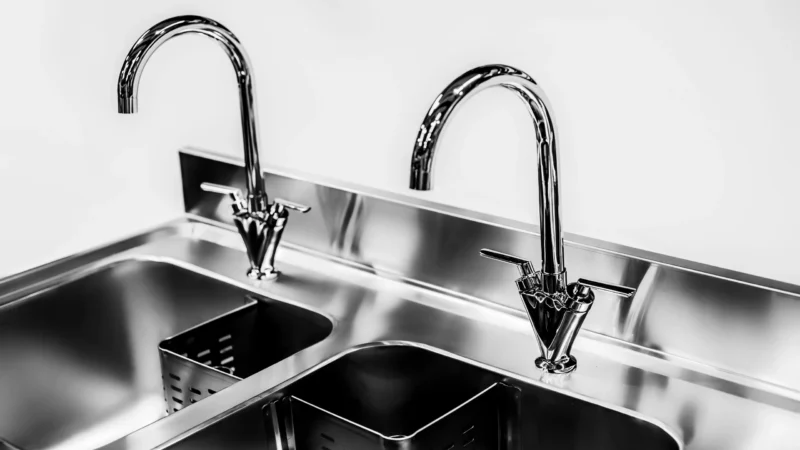
What Is a Tap Gap?
A tap gap is the unobstructed vertical distance between the lowest point of a tap outlet and the spill-over level of the receiving vessel or appliance.
| Property | Value |
|---|---|
| Type AUK2 — tap size up to G½ | Minimum 20 mm gap |
| Type AUK2 — above G½ to G¾ | Minimum 25 mm gap |
| Type AUK2 — above G¾ | Minimum 70 mm gap |
| Type AUK3 tap gap | Minimum 20 mm or twice the inlet-pipe diameter, whichever is greater |
| Type AUK2 protection | Fluid Category 3 (back-siphonage only) |
| Type AUK3 protection | Fluid Category 5 (back-siphonage only) |
| Type AA / AB protection | Fluid Category 5 (back-siphonage and backpressure) |
It provides non-mechanical backflow protection by preventing contaminated water from being drawn backwards into the wholesome water supply through back-siphonage.
Unlike a mechanical device such as a check valve, a tap gap relies on physical separation rather than moving components or seals.
Tap gaps are commonly found on washbasins, kitchen sinks, baths and other sanitary appliances.
The required distance depends on the Fluid Category of the receiving appliance and the relevant tap-gap classification.
What Is an Air Gap?
An air gap is a physical separation between a water supply outlet and the water or receiving vessel downstream.
Air-gap arrangements are classified according to their design and the level of backflow protection they provide.
Common types include:
- Type AA: Air gap with unrestricted discharge.
- Type AB: Air gap with weir overflow.
- Type AD: Air gap with injector.
- Type AG: Air gap with a minimum-size circular overflow determined by measurement or vacuum testing.
Type AA, AB and AD arrangements provide protection against both back-siphonage and backpressure risks up to Fluid Category 5.
Type AG arrangements provide protection up to Fluid Category 3.
Air gaps are commonly incorporated into storage cisterns, break tanks and other water systems requiring physical separation from the wholesome supply.
Understanding the Difference
Tap gaps are themselves recognised forms of air gap. However, a tap gap above a sanitary appliance is not necessarily equivalent to the arrangement provided within a break tank or storage cistern.
The distinction lies in the classification, dimensions and type of backflow risk against which the arrangement provides protection.
For example:
- A Type AUK2 tap gap provides protection against back-siphonage up to Fluid Category 3.
- A Type AUK3 tap gap provides protection against back-siphonage up to Fluid Category 5.
- A Type AB air gap provides protection against both back-siphonage and backpressure up to Fluid Category 5.
The correct arrangement must be selected according to the downstream risk.
A gap that protects against back-siphonage alone must not be assumed to provide protection against backpressure.
Where Is a Tap Gap Suitable?
Tap gaps are suitable where the required physical separation can be maintained between the outlet and the receiving appliance.
The appropriate classification depends on the potential contamination risk.
Type AUK2 — Domestic Tap Gap
A Type AUK2 tap gap provides back-siphonage protection up to Fluid Category 3.
It is commonly used for suitable lower-risk domestic sanitary appliances, including washbasins and baths.
The required minimum vertical distance depends on the tap connection size.
| Tap connection size | Minimum tap gap |
|---|---|
| Not exceeding G½ | 20 mm |
| Exceeding G½ but not exceeding G¾ | 25 mm |
| Exceeding G¾ | 70 mm |
The distance is measured from the lowest point of the outlet, including any fitted aerator or flow straightener, to the spill-over level of the receiving appliance.
Where the required gap cannot be maintained, suitable alternative backflow protection must be provided.
Type AUK3 — Higher-Risk Tap Gap
A Type AUK3 tap gap provides back-siphonage protection up to Fluid Category 5.
It is appropriate for higher-risk applications where a suitable physical gap can be maintained.
Examples include kitchen sinks, laboratory sinks and certain sanitary appliances in healthcare premises.
The minimum vertical distance must be:
- At least 20 mm; or
- Twice the internal diameter of the inlet pipe supplying the fitting.
Whichever is greater.
For example, an inlet-pipe diameter of 15 mm requires a minimum Type AUK3 tap gap of 30 mm.
A Type AUK3 tap gap provides Fluid Category 5 protection against back-siphonage only. It does not provide backpressure protection.
Where Is an Air Gap Required?
Air-gap arrangements are used where the assessed contamination risk requires physical separation of the water supply.
They are particularly relevant to installations involving serious chemical or biological contamination risks.
Examples include:
- Swimming pool replenishment systems.
- Ground-level and below-ground irrigation.
- Commercial or industrial processes.
- Healthcare and laboratory equipment.
- Certain commercial washing and catering installations.
- Rainwater and greywater systems with mains backup.
The appropriate protection depends on the specific application and its assessed Fluid Category.
Type AA Air Gaps
A Type AA air gap provides an unrestricted physical break between the supply outlet and the spill-over level of the receiving vessel.
It provides protection up to Fluid Category 5 against both back-siphonage and backpressure.
The inlet must remain fixed so the required separation is maintained under operating conditions.
The spill-over arrangement must remain unrestricted, and the supply outlet must not come into contact with the contents of the receiving vessel through splashing or foaming.
Type AB Air Gaps
A Type AB air gap provides physical separation between the incoming supply and the downstream water system.
Unlike a Type AA arrangement, a Type AB incorporates a rectangular weir overflow.
The required gap is measured between the supply outlet and the critical water level established by the weir arrangement.
A correctly designed Type AB air gap provides protection against both back-siphonage and backpressure up to Fluid Category 5.
Type AB arrangements are commonly incorporated into break tanks serving systems requiring Fluid Category 5 protection.
Where the downstream installation requires pressurised water, a booster pump can be used to restore the required pressure.
The air gap provides the backflow protection. The pump does not.
Other Air-Gap Classifications
Type AD
A Type AD air gap, sometimes called a jump jet, uses a horizontal injector arrangement. It provides Fluid Category 5 protection against both back-siphonage and backpressure.
Type AG
A Type AG air gap incorporates an overflow designed to meet specific dimensional or performance requirements.
It provides Fluid Category 3 protection against back-siphonage and backpressure and is commonly associated with suitable storage cistern arrangements.
Type AUK1
A Type AUK1 is an interposed cistern arrangement incorporating a Type AG air gap and specific separation requirements between the cistern and receiving appliance.
It provides protection up to Fluid Category 5 against back-siphonage and up to Fluid Category 3 against backpressure.
It is not simply another tap-gap dimension.
Practical Examples
Domestic Washbasin
A washbasin with fixed taps positioned above the spill-over level can use a Type AUK2 tap gap where the assessed risk does not exceed Fluid Category 3.
The required clearance must be maintained throughout normal use.
Kitchen Sink
Kitchen sinks are generally treated as higher-risk applications.
A Type AUK3 tap gap provides suitable Fluid Category 5 back-siphonage protection where the required distance is maintained.
However, adding a pull-out spray hose or modifying the tap can compromise this protection.
If the outlet can become submerged and the required Type AUK3 gap cannot be maintained, an alternative suitable form of backflow protection is required.
Commercial Irrigation
An irrigation system containing fertiliser or chemical dosing equipment requires protection according to the substances present and the complete system risk.
Where the irrigation outlets contact soil or potentially contaminated ground water, the installation can present a Fluid Category 5 risk.
A Type AB break tank arrangement can provide suitable physical separation from the wholesome water supply.
An RPZ valve provides protection only up to Fluid Category 4 and cannot replace the required Fluid Category 5 protection.
Swimming Pool Replenishment
Swimming pool water presents a Fluid Category 5 contamination risk because it contains treatment chemicals and can be biologically contaminated.
An automatic replenishment arrangement must provide suitable protection against contaminated pool water entering the wholesome supply.
A Type AA or Type AB air gap can provide the required separation when correctly designed and installed.
Storage Cisterns
A storage cistern can incorporate a Type AG air gap for suitable Fluid Category 3 applications.
Where the downstream system presents a Fluid Category 5 backpressure risk, a Type AG arrangement alone is not sufficient.
A Type AA or Type AB arrangement can provide the higher level of protection required.
What Can Compromise a Tap Gap or Air Gap?
A correctly designed arrangement must remain effective throughout its working life.
Several common installation and maintenance issues can compromise the required protection.
Hoses and Flexible Outlets
Attaching a hose to a tap can remove the separation originally provided by the tap gap.
For example, a tap may have a compliant Type AUK3 gap above a kitchen sink. If a hose is connected and submerged in contaminated water, the original tap gap is no longer providing the intended protection.
The installation must be reassessed based on the new outlet position and contamination risk.
Changes to Tap Height
Replacing a tap or fitting a different spout can reduce the available clearance above the receiving appliance.
Even a relatively small alteration can make the original tap-gap arrangement non-compliant.
The clearance should be checked whenever an outlet is replaced or modified.
Overflow Arrangements
The spill-over level of a sink, bath or similar vessel is the level at which water would spill over its upper edge.
An overflow opening or pipe does not normally change this reference level.
For break tanks and other designed air-gap arrangements, the overflow configuration can be fundamental to maintaining the required protection.
Blocked weir overflows, incorrect modifications or changes to inlet components can compromise the arrangement.
Poor Maintenance
Air-gap arrangements require suitable inspection and maintenance.
Potential problems include:
- Blocked or restricted overflow arrangements.
- Damaged or displaced inlet components.
- Scale and debris accumulation.
- Alterations to the receiving vessel.
- Inadequate access for inspection.
- Changes in downstream use or contamination risk.
Inspection and maintenance should follow the requirements of the arrangement, the manufacturer’s instructions and applicable guidance.
Common Installation Mistakes
Assuming Any Visible Gap Is Sufficient
A visible space between a tap and an appliance does not automatically provide compliant backflow protection.
The arrangement must satisfy the dimensions and classification required for the downstream risk.
Confusing Type AUK2 and AUK3
A Type AUK2 tap gap provides protection up to Fluid Category 3 against back-siphonage.
A Type AUK3 tap gap provides protection up to Fluid Category 5 against back-siphonage.
Selecting the lower classification for a higher-risk installation can leave the water supply inadequately protected.
Overlooking Backpressure
Not every air-gap arrangement provides protection against backpressure.
The selected arrangement must address the actual type of backflow risk.
For example, Type AUK3 provides Fluid Category 5 back-siphonage protection, while Type AB provides Fluid Category 5 protection against both back-siphonage and backpressure.
Ignoring Changes in Use
An installation originally assessed as low risk can become higher risk if its intended use changes.
Connecting hoses, introducing chemical dosing or changing the receiving appliance can affect the protection required.
The original assessment must be reviewed whenever these changes occur.
Compliance Summary
Tap gaps and air gaps provide non-mechanical protection against contamination of the wholesome water supply.
Their effectiveness depends on the correct classification, dimensions, installation and continued maintenance.
When designing or installing a system:
- Identify the highest downstream Fluid Category risk.
- Establish whether back-siphonage, backpressure or both can occur.
- Select a suitable tap-gap or air-gap arrangement.
- Maintain the required vertical separation and overflow configuration.
- Consider how hoses, modified fittings and changes in use could affect protection.
- Keep the arrangement accessible for inspection and maintenance.
- Confirm the proposed protection with the local water undertaker where required.
The presence of an air space alone does not establish compliance. The arrangement must provide the correct level of protection for the installation.